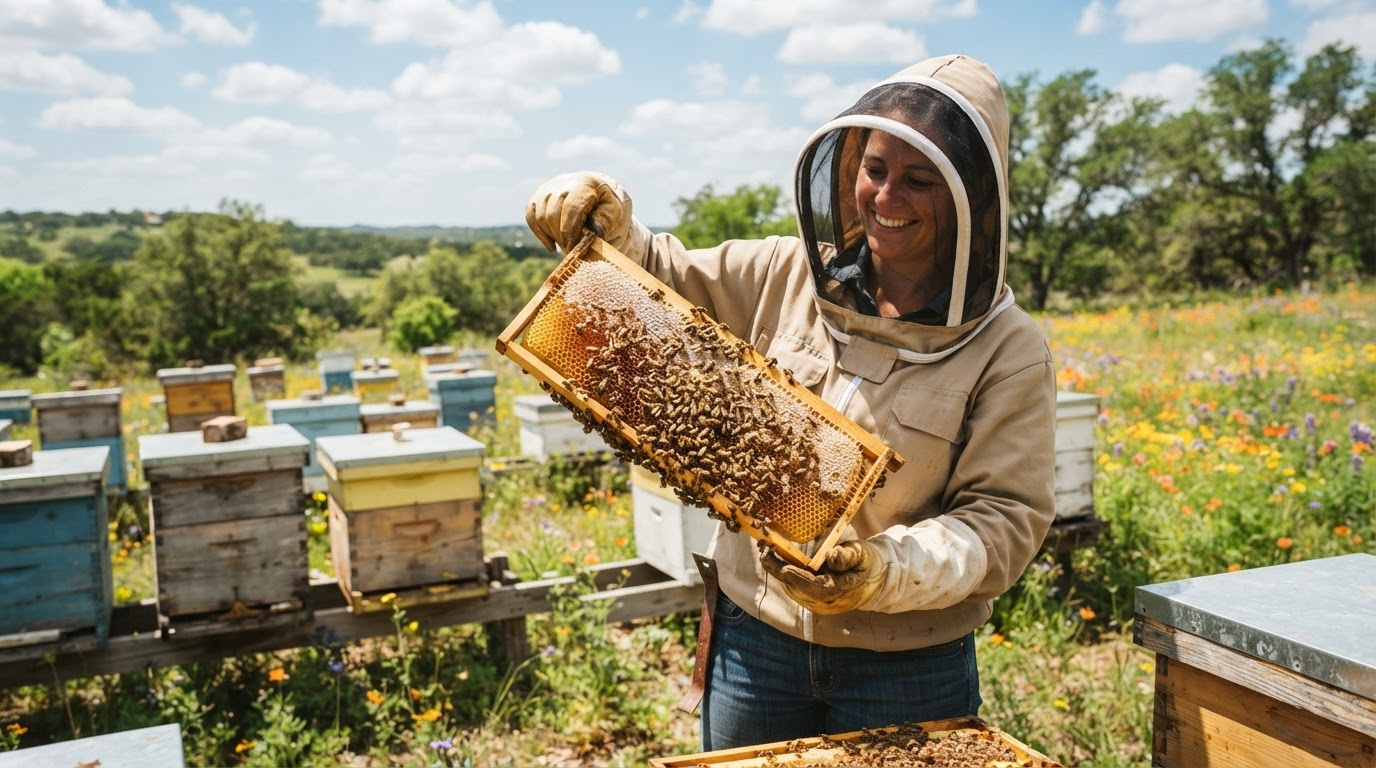
Welcome to the rewarding world of Texas beekeeping! Whether you're looking to produce your own raw honey, support local Hill Country agriculture, establish an agricultural valuation, or help pollinators thrive, keeping bees in Texas offers unique opportunities and challenges.
Benefits of Beekeeping in Texas
Texas offers excellent conditions for beekeeping, with our long growing seasons and rich, diverse flora. As a Texas beekeeper, you'll enjoy:
- Year-round beekeeping opportunities in most South and Central Texas regions
- Multiple honey flows from various Texas wildflowers, mesquite, horsemint, and agricultural crops
- Extended breeding seasons compared to northern states
- Direct opportunities to support local Hill Country agriculture and neighboring gardens
- Fresh, local raw honey with distinct Texas floral profiles
- Natural pollination for your acreage, orchard, and surrounding native habitat
Choosing the Perfect Location for Your Texas Hive
Texas weather presents specific considerations for hive placement that northern beekeeping manuals often overlook. Careful site selection is the foundation of healthy colonies.
Sun & Shade Balance
- Morning sun is crucial to get colonies warm and flying early, but afternoon shade is vital during intense Texas summer heat.
- Consider placing hives under filtered, dappled shade from native trees such as cedar elm, live oak, or mesquite.
- East-to-southeast-facing entrances catch early sunlight, prompting worker bees to begin foraging before the peak heat of the day.
- Avoid direct, unshaded full southern exposure during July and August.
Water Sources
- Provide consistent, dedicated water sources within 50 feet of the apiary.
- Use shallow water containers filled with gravel, corks, or floating sticks so bees can drink without drowning.
- Consider automated drip or poultry-fount watering systems during extreme Hill Country summers.
- Keep water filled year-round — if bees establish your neighbor's swimming pool as their primary source, retraining them is difficult.
Protection from Elements & Predators
- Shield hives from prevailing winter winds (typically northerly fronts).
- Elevate hives on sturdy cinder blocks or stands to deter fire ants, skunks, armadillos, and ground moisture.
- Ensure solid hive-stand level with a slight forward pitch so rainwater drains away from the entrance.
- Keep flash flood potential in mind when choosing low-lying creek or drainage areas.
Essential Equipment for Texas Beekeeping
Standard equipment includes 10-frame Langstroth hive bodies, screened bottom boards for hot-weather ventilation, deep frames with wax foundation, inner and outer telescoping covers, a high-quality hive tool, bee brush, bee smoker, and lightweight protective suit suited for Texas heat.
Texas-specific additions that make a major difference in colony survival:
- Screened bottom boards and slatted racks for summer heat dissipation
- Entrance reducers and robbing screens (critical during mid-summer dearth when forage is scarce)
- Small hive beetle (SHB) traps with vegetable oil or food-grade diatomaceous earth
- Extra medium honey supers ready ahead of spring wildflower flows
Step-by-Step Hive Setup & Installing Your Bees
In Central and South Texas, mid-April through May is prime time for installing nucleus colonies (nucs) and package bees. Here is the field-proven process:
- Foundation & Stand: Clear and level ground, position cinder blocks, and set the screened bottom board with an entrance reducer.
- Position the Brood Box: Place your deep hive body onto the bottom board.
- Transfer Nuc Frames: Gently move the 5 nuc frames in their exact original order into the center of the deep box, placing blank frames on either flank.
- Feeding & Cover: Provide 1:1 sugar syrup in an internal feeder to help bees draw comb quickly. Place the inner cover and secure the outer telescoping lid.
- Inspection: Allow the colony 5 to 7 days undisturbed before your first gentle inspection to verify the queen is laying.
Seasonal Care in Texas
Beekeeping in the Hill Country and South Texas follows distinct seasonal rhythms:
- Spring (March–May): Install new nucs; monitor for swarm preparation; add honey supers during bluebonnet, agarita, and wildflower blooms; verify queen laying pattern.
- Summer (June–August): Ensure adequate ventilation and shade; refill fresh water daily; watch for robbing behavior during summer dearth; protect hives from extreme heat.
- Fall (September–November): Monitor goldenrod and broomweed fall flow; inspect honey stores for winter; reduce entrance size; monitor for small hive beetles; treat for Varroa mites if thresholds warrant.
- Winter (December–February): Monitor food reserves; provide windbreaks against northern freezes; keep entrances clear; prepare equipment for early spring buildup.
Understanding Texas Honey Bee Varieties
Choosing the right bee stock for Texas heat and local forage makes all the difference for both new and experienced beekeepers:
- Hawaiian Honey Bees: Renowned for gentle temperament, exceptional honey production, strong Varroa resistance, excellent comb-building, and resilience in hot climates — ideal for beginners and property owners.
- Italian Bees (Apis mellifera ligustica): The most popular North American bee. Prolific brood rearing, gentle nature, excellent honey producers, and well-suited to Texas climate.
- Carniolan Bees (Apis mellifera carnica): Darker bees known for rapid spring buildup, conservative winter food consumption, and lower tendency to rob during summer dearth.
- Buckfast Hybrid Stock: Hardy, disease-resistant, gentle, and strong foragers through Texas heat.
- Africanized Bees ( feral ): Found throughout Central and South Texas. Highly defensive and prone to excessive swarming. Maintaining gentle, marked European queens in managed hives prevents Africanized traits from dominating.
Important disclaimer
This article is general information, not legal or tax advice. Agricultural valuation requirements vary by county and are determined solely by your county appraisal district. Happy Bee Solutions provides beekeeping services and documentation only and cannot guarantee an agricultural valuation, tax savings, or any specific outcome. Consult your CAD and a qualified professional before filing.
Think your land could qualify?
Beekeeping is one of the agricultural uses recognized in Texas. We place, maintain, and document managed hives for landowners across Central & South Texas — Kelly or Paul will walk you through whether it's a realistic fit for your acreage.