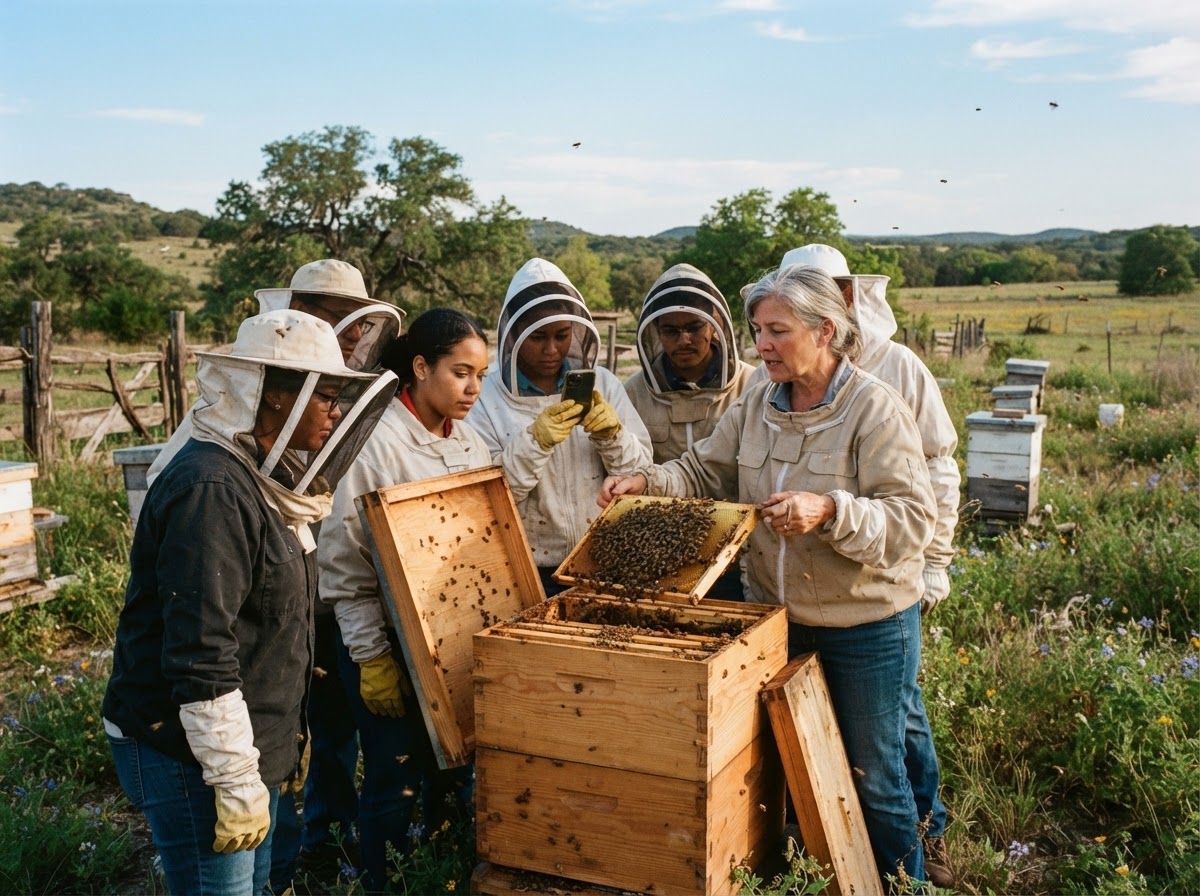
Confidence at the hive, not just theory
Every class is taught outdoors at the apiary with live colonies. You leave able to open a hive, read what you see, and know what to do next.
Bee basics & biology
The colony, the castes, and a year in the life of a Texas hive.
Gear & getting started
What to wear, what to buy, and how to light a smoker that stays lit.
Hands-on inspections
Find the queen, read the brood, and spot trouble before it spreads.
The seasonal rhythm
What to do each season — from splits to over-wintering in Texas.
2026 class calendar
All classes held at the New Braunfels apiary · gear provided
Beekeeping 101
Your first frame. Hive biology, gear, and a guided inspection of a live colony.
Inspection Lab
Hands-on practice reading frames, finding the queen, and assessing colony health.
Splits & Swarm Season
Make your own nucs, manage the spring swarm impulse, and grow your apiary.
Harvest & Honey Day
Pull supers, extract, bottle, and taste your way through the Hill Country flow.
Skip the classroom. Suit up and work the yards.
The fastest way to learn beekeeping is to open a lot of hives — not just one or two. On a ride-along day you go out with Paul as he works his route, opening several hives a day across different yards. You'll see queen-right colonies, weak ones, swarm cells, brood breaks, and everything in between — the kind of real-world experience you can't get from a single hive in a single afternoon.
- Open multiple hives a day across several yards
- Read different colony conditions side by side
- Hands-on — you hold the frames, Paul guides
- Spring and fall ride-along days available
What a ride-along day looks like
- 1
Suit up, light the smoker, and load the truck for the day's route.
- 2
Visit multiple apiaries — each one shows you a different stage of colony life.
- 3
Paul hands you the hive tool. You pull frames, spot the queen, and call what you see.
- 4
By the end of the day you've seen a dozen colonies — that's what makes a beekeeper.
The best living science lab in your backyard
A hive teaches life cycles, pollination, biology, and stewardship better than any textbook. We welcome homeschool families, 4-H groups, and curious kids — veils fit small heads too, and parents learn right alongside them.
Homeschool & 4-H groups
Bring your co-op for a private hive day — biology, pollination, and a guided inspection tailored to your students' ages.
Garden & pollinator days
Pair a hive with your vegetable garden or orchard — learn how pollinators turn blossoms into your harvest.
Family-friendly & pet-safe
Gentle colonies, safe hive placement, and patient teaching — so kids, dogs, and bees all share the yard happily.
What a family hive day looks like
- 1
Veils and gloves for everyone — sized down for the kids.
- 2
Find the queen, read the brood, and watch bees at work.
- 3
Pull a frame, taste fresh honey, and talk pollination.
- 4
Leave with a seasonal checklist and a hive to watch all year.
Online beekeeping programs we trust
Can't make it to a Hill Country class? These trusted online programs from Texas A&M AgriLife Extension, the Texas Master Beekeeper Program, and Cornell let you learn at your own pace — then come put hands on frames with us.
Beekeeping 101
Texas A&M AgriLife Extension
A free online introduction to beekeeping — hive biology, equipment, and seasonal management straight from Texas A&M's extension experts.
Start the free courseMaster Beekeeper Program
Texas A&M University
A structured certification program for beekeepers ready to go deeper — from apprentice to master, with exams and fieldwork in Texas.
Explore certificationBeekeeping Essentials
Cornell University Online
A self-paced online course covering honey bee biology, colony management, and pollination — taught by Cornell's entomology faculty.
View the courseThese programs are operated by their respective universities and organizations. Happy Bee Solutions is not affiliated with them — we just think they're a great way to keep learning between visits to the apiary.
Save your seat at the hive
Classes stay small so everyone gets time at the frames. Reserve early — spring sessions fill first.