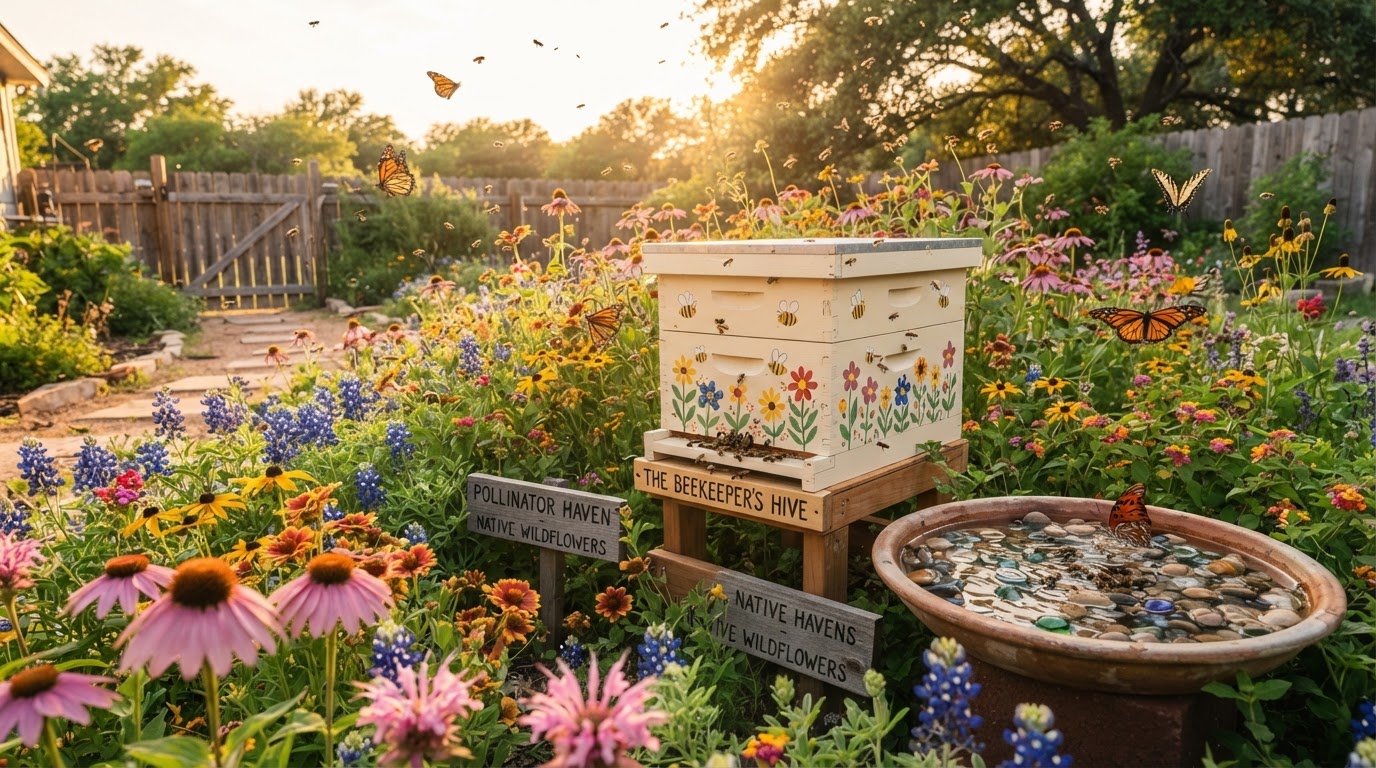
Honey bees and native pollinators face significant challenges — from habitat loss and forage fragmentation to pesticide exposure and climate extremes. The good news is that Texas landowners, ranchette owners, and suburban homeowners can make a direct, tangible difference right on their property.
1. Plant a Texas Bee Garden
One of the greatest threats to bees is a lack of safe, diverse forage where they can find nutritious nectar and pollen throughout the year. By planting a bee garden, you create a haven of continuous blooms across seasons.
- Plant a variety of shapes, sizes, and colors — bees are particularly attracted to purple, blue, white, and yellow blossoms.
- Focus on Texas native plants: bluebonnets, Indian blanket, purple coneflower, Mexican hat, Texas lantana, and horsemint (bee balm).
- Aim for staggered bloom windows from early spring through late autumn so bees have forage during critical buildup and winter-prep periods.
- Even small spaces help — window boxes, raised beds, garden borders, and ranch road edges all add up.
2. Go Chemical-Free for Pollinators
Synthetic pesticides, broad-spectrum insecticides, and systemic neonicotinoids are devastating to honey bees and beneficial insects. They disrupt navigation, weaken immune systems, and contaminate pollen brought back to feed developing brood.
- Avoid spraying flowering plants, weeds, or lawns when blooms are open and pollinators are active.
- Embrace integrated pest management (IPM) — encouraging natural predators like ladybugs, lacewings, and birds.
- If treatment is unavoidable, choose targeted organic solutions applied at dusk when honey bees have returned to the hive.
- Never spray pesticides directly into standing water sources where bees drink.
3. Provide Trees for Bees
Many people don't realize that honey bees collect a substantial portion of their seasonal nectar and pollen from trees. When a mature Texas tree blooms, it offers thousands of blossoms in one compact footprint.
- Native Texas trees like Redbuds, Texas Persimmon, Anacua, Desert Willow, and Mexican Plum provide abundant early spring forage.
- Mesquite and Huisache are major nectar producers in Central and South Texas, producing light, delicious honey.
- Tree resins provide the raw material bees collect to produce propolis, their natural hive sealant and antibacterial shield.
- Trees also provide windbreaks, moderate microclimates, prevent soil erosion, and sequester carbon.
4. Live Bee Removal Instead of Extermination
Have bees established a nest in your wall, soffit, barn, or tree hollow? Don't reach for an exterminator's spray. Honey bees are invaluable pollinators, and spraying a colony inside a wall leaves rotting brood and fermenting honey that attracts pests and causes structural damage.
- Happy Bee Solutions provides safe, humane live bee removals throughout Comal, Guadalupe, Bexar, Hays, Kendall, Blanco, Caldwell, and Bastrop counties.
- Colonies are relocated to our managed apiaries where they continue producing honey and pollinating Texas flora.
- Nighttime removals are preferred when practical so the entire foraging population is captured with the hive.
- Before calling, note the height, location, cluster size, and drive-up access so our beekeeping team can arrive prepared.
Need swarm capture or structural bee removal in Central or South Texas? Call Paul directly at 210-396-0183.
Important disclaimer
This article is general information, not legal or tax advice. Agricultural valuation requirements vary by county and are determined solely by your county appraisal district. Happy Bee Solutions provides beekeeping services and documentation only and cannot guarantee an agricultural valuation, tax savings, or any specific outcome. Consult your CAD and a qualified professional before filing.
Think your land could qualify?
Beekeeping is one of the agricultural uses recognized in Texas. We place, maintain, and document managed hives for landowners across Central & South Texas — Kelly or Paul will walk you through whether it's a realistic fit for your acreage.